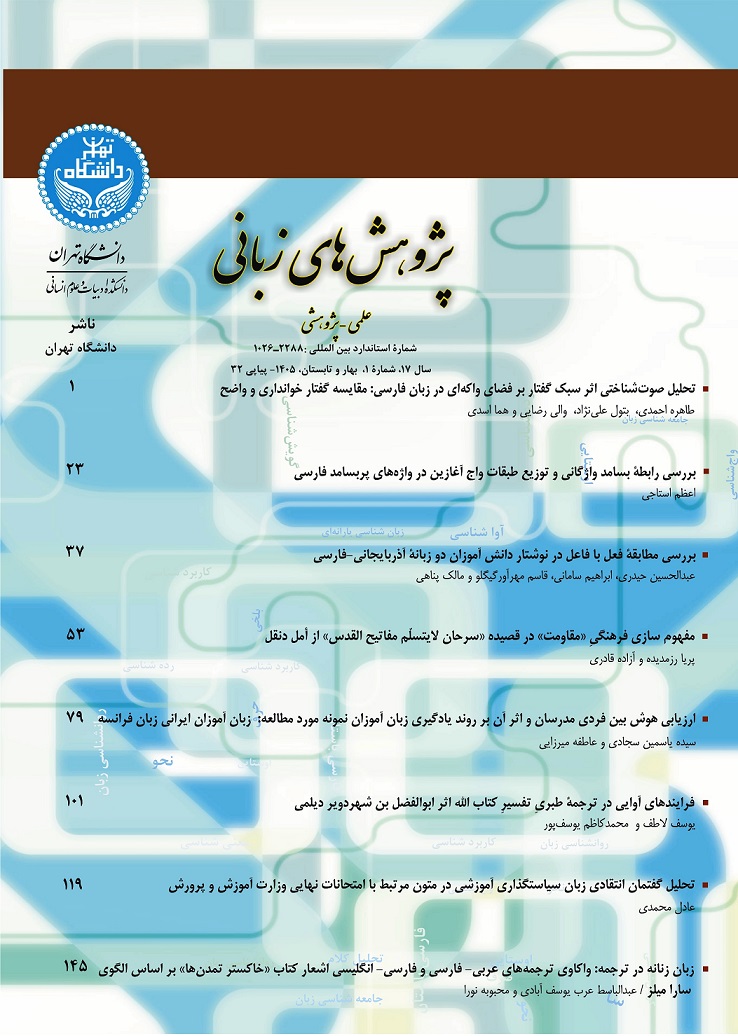
تحلیل صوت‌شناختی اثر سبک گفتار بر فضای واکه‌ای در زبان فارسی: مقایسه گفتار خوانداری و واضح

نوع مقاله : مقاله پژوهشی

نویسندگان

1 دانشجوی دکترای زبان‌شناسی، گروه زبان‌شناسی، دانشکده زبان‌های خارجی، دانشگاه اصفهان، اصفهان، ایران

2 دانشیار گروه زبان شناسی، دانشکده زبان‌های خارجی، دانشگاه اصفهان، اصفهان، ایران

3 دانشیار گروه زبان‌شناسی، دانشکده زبان‌های خارجی، دانشگاه اصفهان، اصفهان، ایران

4 استادیار گروه زبان‌شناسی، دانشکده زبان‌های خارجی، دانشگاه اصفهان، اصفهان، ایران

چکیده
پژوهش حاضر در چهارچوب آواشناسی صوت‌شناختی به بررسی و مقایسه فضای واکه‌ای در دو سبک گفتاری خوانداری و واضح در زبان فارسی می‌پردازد. سبک گفتار یکی از عوامل مؤثر بر الگوهای تولید واکه‌ها و سازمان‌دهی فضای واکه‌ای است و می‌تواند موجب تغییر در میزان تمایز و پراکندگی واکه‌ها شود. با وجود پژوهش‌های متعدد درباره گفتار واضح در زبان‌های مختلف، بررسی نظام‌مند تأثیر سبک گفتار بر فضای واکه‌ای زبان فارسی، به‌ویژه با در نظر گرفتن عامل جنسیت و تغییرات بین‌گوینده، همچنان محدود است. نوآوری پژوهش حاضر در بررسی هم‌زمان اثر سبک گفتار، جنسیت و تغییرات بین‌گوینده بر فضای واکه‌ای واکه‌های فارسی و تحلیل آن‌ها بر اساس شاخص‌های صوت‌شناختی مانند VSA، VCI و پراکندگی F1 و F2 است.داده‌های پژوهش شامل نمونه‌های گفتاری 25 گوینده فارسی‌زبان (زن و مرد) در دو سبک گفتاری خوانداری و واضح است که به‌صورت میکروفونی و در محیط آزمایشگاهی ضبط شدند. پس از استخراج بسامدهای سازه‌ای اول و دوم واکه‌ها، داده‌ها با استفاده از نرم‌افزارهای Python و R و بر مبنای روش نری تحلیل شدند. در این پژوهش از شاخص‌هایی مانند مساحت فضای واکه‌ای، شاخص تمرکز واکه‌ها و تحلیل تغییرات بین‌گوینده استفاده شد. نتایج نشان داد که سبک واضح در مقایسه با سبک خوانداری دارای فضای واکه‌ای گسترده‌تر و پراکندگی واکه‌ای بیشتری است. افزایش میانگین F1 در سبک واضح نیز بیانگر بازشدگی بیشتر دهان و افزایش دامنه حرکتی عمودی در تولید واکه‌هاست. همچنین مشخص شد که زنان در هر دو سبک گفتاری فضای واکه‌ای بزرگ‌تر و شاخص تمرکز واکه‌ای بالاتری نسبت به مردان دارند. بررسی تغییرات بین‌گوینده نیز نشان داد که مردان در هر دو بعد F1 و F2 پراکندگی بیشتری نسبت به زنان دارند، در حالی که زنان در سبک واضح انسجام تولیدی بیشتری نشان می‌دهند. افزون بر این، واکه‌های گرد، به‌ویژه/u/، بیشترین حساسیت را نسبت به تغییرات سبک و جنسیت نشان دادند. یافته‌های این پژوهش نشان می‌دهد که سبک گفتار و جنسیت به‌صورت تعاملی بر سازمان‌دهی فضای واکه‌ای زبان فارسی اثر می‌گذارند و گفتار واضح با افزایش تمایز واکه‌ای و گسترش فضای صوت‌شناختی همراه است. این نتایج می‌تواند در گسترش مطالعات مربوط به آواشناسی صوت‌شناختی و تغییرات سبک گفتار در زبان فارسی مورد استفاده قرار گیرد.

کلیدواژه‌ها


عنوان مقاله English

Acoustic Analysis of the Effect of Speech Style on the Vowel Space in Persian: A Comparison of Read and Clear Speech

نویسندگان English

Tahere Ahmadi 1
Batool Alinezhad 2
Vali Rezai 3
Homa Asadi 4
1 PhD Candidate in linguistics, Department of Linguistics, Faculty of Foreign Languages, University of Isfahan, Isfahan, Iran
2 Associate Professor, Department of Linguistics, Faculty of Foreign Languages, University of Isfahan, Isfahan, Iran.
3 Associate Professor, Department of Linguistics, Faculty of Foreign Languages, University of Isfahan, Isfahan, Iran.
4 Assistant Professor, Department of Linguistics, Faculty of Foreign Languages, University of Isfahan, Isfahan, Iran.
چکیده English

This study investigates and compares vowel space in two speech styles, read speech and clear speech, in Persian within the framework of acoustic phonetics. Speech style is an important factor influencing vowel production patterns and the organization of vowel space, as it may lead to systematic changes in vowel dispersion and distinctiveness. Although clear speech has been widely studied across different languages, systematic evidence on Persian vowel space variation across speech styles, particularly considering gender and inter-speaker variability, remains limited. The main novelty of this study lies in the joint examination of speech style, gender, and inter-speaker variation in shaping vowel space using acoustic measures such as Vowel Space Area (VSA), Vowel Centralization Index (VCI), and F1/F2 dispersion.The data consist of speech recordings from 25 Persian speakers (male and female) produced in two speech styles: read and clear speech. Recordings were collected in a controlled acoustic laboratory setting. Following the extraction of first and second formant frequencies (F1 and F2), the data were analyzed using Python and R, and normalized based on the Neary scale. The analysis included measures of vowel space area, vowel centralization, and inter-speaker variability.The results indicate that clear speech exhibits a significantly larger vowel space compared to read speech, accompanied by greater vowel dispersion. An increase in F1 values in clear speech suggests greater jaw opening and increased vertical articulatory movement. It was also found that female speakers demonstrate a larger vowel space and higher vowel distinctiveness compared to male speakers in both speech styles. Regarding inter-speaker variation, males show greater dispersion in F1 and F2, whereas females exhibit more stable vowel production in clear speech. Furthermore, rounded vowels, particularly /u/, are the most sensitive to changes in both speech style and gender. Overall, the findings suggest that speech style and gender interactively shape the organization of vowel space in Persian. Clear speech is characterized by enhanced vowel distinctiveness and an expanded acoustic vowel space, contributing to a more detailed understanding of stylistic variation in acoustic phonetics.

کلیدواژه‌ها English

Vowel
vowel space
reading speech
clear speech
phonological analysis
speech recognition
اسفندیاری، نسیم و بتول علی‌نژاد (1394). بهنجارسازی فضای واکه‌ای زبان فارسی. مجله پژوهش‌های زبان‌شناسی، سال هفتم، شماره دوم، شماره ترتیبی 13، پاییز و زمستان 1394، 15-34.
Adank, P., Smits, R., & Van Hout, R. (2004). A comparison of vowel normalization procedures for   language variation research. The Journal of the Acoustical Society of America, 116(5),                          3099–3107.
Arantes, P. (2021). Effects of speaking style on the shape of fundamental frequency distributions.       Revista da ABRALIN, 20(1), 1–39.
Aronow, R., McHugh, B. D., & Molnar, T. (2017). A pilot acoustic study of Modern Persian vowels in colloquial speech. Proceedings of the Linguistic Society of America, 2, 1-17.
Asadi, H., Nourbakhsh, M., Sasani, F., & Dellwo, V. (2018). Examining long-term formant frequency as a forensic cue for speaker identification: An experiment on Persian. In                              Proceedings of the First International Conference on Laboratory Phonetics and Phonology,                21–28.
Barreda, S. (2021). Perceptual validation of vowel normalization methods for variationist research.     Language Variation and Change, 33(1), 27–53.
Barreda, S., & Nearey, T. M. (2018). A regression approach to vowel normalization for missing and  unbalanced data. The Journal of the Acoustical Society of America, 144(1), 500–520.
Bradlow, A. R., Torretta, G. M., & Pisoni, D. B. (1996). Intelligibility of normal speech I: Global     and fine-grained acoustic-phonetic talker characteristics. Speech Communication, 20(3–4),                  255–272.
Coulthard, M., May, A., & Sousa-Silva, R. (2021). The Routledge handbook of forensic linguistics.   Routledge.
Esfandiari, N., & Alinajad, B. (2015). Normalization of the vowel space in Persian. Journal of          Linguistic Research, 7(2), 15–34.[ In Persian].
Fant, G. (1971). Acoustic theory of speech production: With calculations based on X-ray studies of    Russian articulations. Walter de Gruyter.
Field, A. (2013). Discovering statistics using IBM SPSS statistics (4th ed.). Sage.
Hargus Ferguson, S. (2004). Talker differences in clear and conversational speech: Vowel     intelligibility for normal-hearing listeners. The Journal of the Acoustical Society of
              America, 116(4), 2365-2373.
Ferguson, S. H., & Kewley-Port, D. (2007). Talker differences in clear and conversational speech:    Acoustic characteristics of vowels. Journal of Speech, Language, and Hearing Research,
              50(5), 1241–1255.
Jacewicz, E., Fox, R. A., & Salmons, J. (2011). Cross-generational vowel change in American         English. Language Variation and Change, 23(1), 45–86.
Jones, T. (2019). A corpus phonetic study of contemporary Persian vowels in casual speech.
Koffi, E., & Krause, J. (2020). Speech style variation of vowels in citation form vs. running speech: Intelligibility implications for AI-enabled devices. Linguistic Portfolios, 9(1), 6.
Kuo, C., & Berry, J. (2023). The relationship between acoustic and kinematic vowel space areas        with and without normalization for speakers with and without dysarthria. American Journal
              of Speech-Language Pathology, 32(4S), 1923–1937.
Lam, J., Tjaden, K., & Wilding, G. (2012). Acoustics of clear speech: Effect of instruction. Journal  of Speech, Language, and Hearing Research, 55(6), 1807–1827.
Lam, J., & Tjaden, K. (2013). Intelligibility of clear speech: Effect of instruction. Journal of Speech,            Language, and Hearing Research, 56(5), 1429-1440.
Lindblom, B. (1990). Explaining phonetic variation: A sketch of the H & H theory. In Speech           production and speech modelling, 403–439.
Mokari, P. G., Werner, S., & Talebi, A. (2017). An acoustic description of Farsi vowels produced by            native speakers of Tehrani dialect. The Phonetician Journal of the International Society of
Phonetic Sciences, 114, 6–23.
Nearey, T. M. (1978). Phonetic feature systems for vowels. Indiana University Linguistics Club.
Pellegrino, E., Asadi, H., Dellwo, V., Skarnitzl, R., & Volín, J. (2023). Voice discrimination across speaking styles in Persian. In Proceedings of the International Congress of Phonetic       Sciences.
Picheny, M. A., Durlach, N. I., & Braida, L. D. (1986). Speaking clearly for the hard of hearing II:  Acoustic characteristics of clear speech. Journal of Speech, Language, and Hearing    Research, 29(4), 434–446.
Ronquest, R. (2016). Stylistic variation in heritage Spanish vowel production. Heritage Language     Journal, 13(2), 275–298.
Sapir, S., Ramig, L. O., Spielman, J. L., & Fox, C. (2010). Formant centralization ratio: A proposal for a new acoustic measure of dysarthric speech.
Shapiro, S. S., & Wilk, M. B. (1965). An analysis of variance test for normality (complete samples). Biometrika, 52(3–4), 591–611.
Strycharczuk, P., & Kirkham, S. (2025). Articulatory strategies in male and female vowel    production. Journal of Speech, Language, and Hearing Research, 1–21.
Tabachnick, B. G., & Fidell, L. S. (2019). Using multivariate statistics (7th ed.). Pearson.
Vangel, M. G. (1996). Confidence intervals for a normal coefficient of variation. The American        Statistician, 50(1), 21–26.
Wang, Q. (2019). Stylistic variation in vowel production: Evidence from China English. In  Proceedings of the 19th International Congress of Phonetic Sciences.
Whitfield, J. A., & Goberman, A. M. (2014). Articulatory-acoustic vowel space: Application to clear            speech in individuals with Parkinson's disease. Journal of Communication Disorders, 51,  19–28.
Whitfield, J. A., & Goberman, A. M. (2017). Articulatory-acoustic vowel space: Associations           between acoustic and perceptual measures of clear speech. International Journal of Speech-
Language Pathology, 19(2), 184–194.
Whitfield, J. A., & Mehta, D. D. (2019). Examination of clear speech in Parkinson disease using       measures of working vowel space. Journal of Speech, Language, and Hearing Research,           62(7), 2082–2097.
  • تاریخ دریافت 08 بهمن 1404
  • تاریخ بازنگری 30 اردیبهشت 1405
  • تاریخ پذیرش 21 شهریور 1405